One of Peopling the Past’s goals is to amplify the work of young and/or under-represented scholars and the amazing research that they are doing to add new perspectives to the fields of ancient history and archaeology (broadly construed). We will thus feature several blog posts throughout the year interviewing graduate students on their research topics, focusing on how they shed light on real people in the past.
What topic do you study?
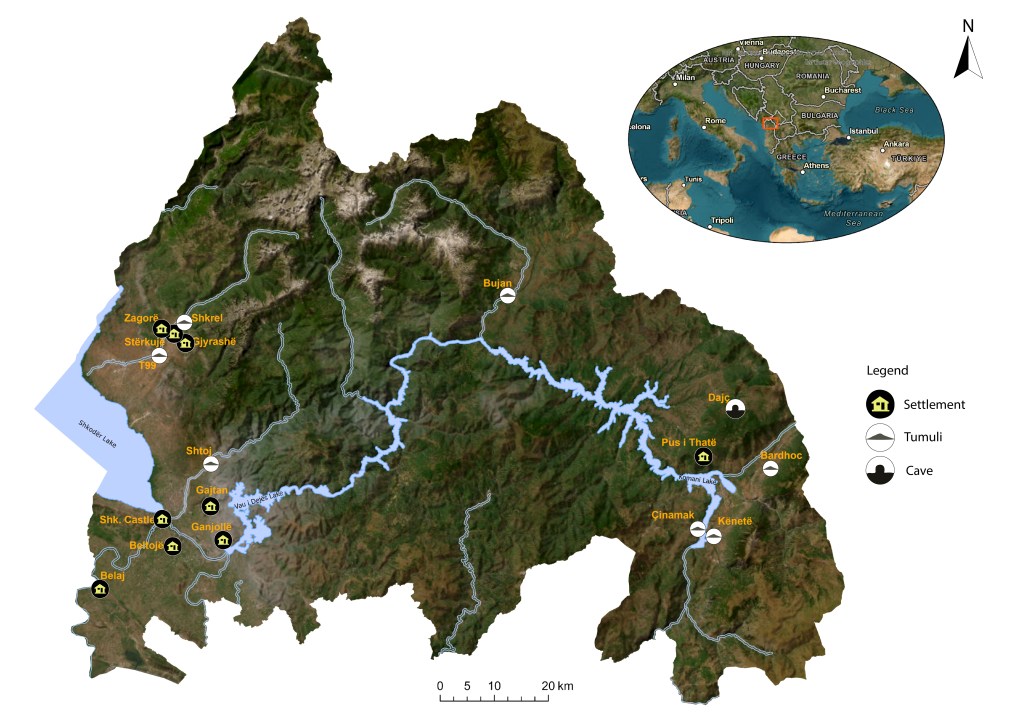
I am an archaeologist conducting my Ph.D. at the Department of Art History, University of Toronto (UofT), where I also completed the Mediterranean Archaeology Collaborative Specialization Program. I explore the social organization of groups of people who inhabited northern Albania during the third millennium BCE, the Early and Middle Bronze Ages (EBA, MBA). This small area between the southeastern Adriatic and the Balkan hinterlands is still largely unexplored, and I aim to shed light on its significance in the central Mediterranean.
During my master’s degree at Mississippi State University, I was involved in the Shkodra Arkeological Project, where I studied prehistoric pottery collections. This project inspired me to extend my doctoral project toward the northeast of Albania and compare pottery collections systematically to address questions about community organization, mobility, and social diversification. I have been focusing on legacy collections – that is, archaeological finds from excavations that were only partly published in field reports. This is the first time these collections are systematically being analyzed using a consistent method.
The societies of the Balkans appear to have undergone significant changes at the beginning of the third millennium BCE. These transformations can be observed from an increased number of settlements, the adoption of burial mounds, and new kinds of material culture, especially pottery types. These changes have traditionally been explained as the result of a population migration from the Russian steppe, postulating that these ‘foreign’ groups – “Kurgan IV” or ‘pit grave’ culture – intermingled with local communities, marking an “interruption” of the Eneolithic lifestyle (Gimbutas 1956; Harding 2012; Prendi 1982). While this hypothesis remains debated (Mathieson et al. 2018), recent scholarship attributes additional changes around mid-late third millennium BCE to a hyperconnected Adriatic where the mobility of Cetina people (from today’s Dalmatia), known for building tumuli and producing distinctive pottery types, changed the cultural landscape of the entire region, reaching southern Italy and continental Greece (Gori 2020). This habit of accounting for change through large-scale international connections, especially through the debates around Cetina culture, minimizes the potential role of local communities in innovation.

In this light, my project addresses questions explicitly related to the nature of prehistoric local communities in northern Albania. First, it is important to establish the origin of the pottery collected across settlements. Are they all local, or is there also a consistent presence of imported objects? Technology is another important aspect to consider. Through a technological lens, one can identify a series of choices that vary site by site and which might tell us about regional or sub-regional groupings. A useful framework here is the chaîne opératoire, a concept of technological choice around which one can organize and compare observations about the regional pottery. Technology is crucial because it directly reflects the degree to which ancient people shared recipes and other strategies for pottery production. In other words, the intention is to understand how people living in northern Albania during the third millennium BCE constructed their local identity in the face of widespread connections.
What sources or data do you use?
My research is cross-disciplinary. I combine macroscopic and microscopic data collected through the analysis of pottery, information on geological samples, gathered with radiocarbon data on short-lived samples in the study area. Intertwining such data helps to examine their similarities and differences within sites, between sites, and regions.


I spent most of 2023 working in collections at the Institute of Archaeology and the Department of Archaeology and Cultural Heritage Management (DACHM) at the University of Tirana (UT) in Albania. I studied prehistoric pottery collected from six sites, four in northeastern Albania and two in the northeast, most excavated between 1961 and 1987. One assemblage was excavated in 2022 thanks to an interdepartmental agreement between Art History at UofT and DACHM at UT, where I co-directed alongside Drs. Carl Knappett and Lorenc Bejko. Systematic macroscopic analysis collected during this time helps to understand stylistic and morphological variations across regions. On a microscopic scale, it is possible to identify specific clay mixing traditions that are not visible outside.
How does this research shed light on real people in the past?
Research shows that pottery production is an organized process that engages people, their knowledge and skills, and a set of tools and gestures. During this process, some aspects of pottery-making are transmitted and learned consciously from one individual or group to the other, and some others are embodied unconsciously. This systematic engagement between humans and materials provides two levels of understanding real people in the past. First, we can see whether and to what extent people transmitted their knowledge on pottery production. Second, it permits us to understand individual choices in certain collections. In this way, it is possible to see how people interacted between them and their natural environment. These behaviors are closely tied to a particular cultural background.
Bibliography and Further Reading
Gimbutas, Marija. The Prehistory of Eastern Europe. Peabody Museum, 1956.
Gori, Maja. “Kατὰ Γῆν Καὶ Κατὰ Θάλασσαν. Cetina Communities on the Move across the Central Mediterranean and the Balkans in the 3rd Millennium BC.” In Objects, Ideas and Travelers Contacts between the Balkans, the Aegean and Western Anatolia during the Bronze and Early Iron Age: Volume to the Memory of Alexandru Vulpe: Proceedings of the Conference in Tulcea, 10-13 November 2017, edited by Joseph Maran, Radu Băjenaru, Sorin-Cristian Ailincăi, Anca-Diana Popescu, Svend Hansen, and Alexandru Vulpe, 65–83. Bonn: Verlag Dr. Rudolf Habelt GmbH, 2020.
Harding, Anthony. “The Tumulus in European Prehistory: Covering the Body, Housing the Soul.” MOM Éditions 58, no. 1 (2012): 21–30.
Mathieson, Iain, Songül Alpaslan-Roodenberg, Cosimo Posth, Anna Szécsényi-Nagy, Nadin
Rohland, Swapan Mallick, Iñigo Olalde, et al. “The Genomic History of Southeastern Europe.” Nature 555, no. 7695 (March 2018): 197–203.
Prendi, Frano. “The Prehistory of Albania.” In The Cambridge Ancient History: The Prehistory of the Balkans and the Middle East and the Aegean World, Tenth to Eighth Centuries B. C., edited by John Boardman, I. E. S. Edwards, N. G. L. Hammond, and E. Sollberger, Second., III:187–237. London: Cambridge University Press., 1982.

Anisa Mara is currently a PhD Candidate at the Department of Art History at the University of Toronto. As part of her PhD program, in 2020, Anisa also completed the Mediterranean Archaeology Specialization Program. Her background includes numerous archaeological projects across the Mediterranean, such as Albania, Kosovo, Italy, and Greece. Her interest is tied to the Bronze Age western Balkans, where she investigates community interaction and knowledge transmission across settlements in northern Albania by examining Bronze Age pottery. In May 2022, Anisa co-directed the “Gjyrashë Archaeological Project” in northern Albania, a collaborative project between University of Toronto and the Department of Archaeology and Cultural Heritage at the University of Tirana (Albania). She was the team leader of Regional Archaeology in the Peja and Istog Districts of Kosovo (RAPID-K) survey project in Kosovo, which is related to her research interests. The Rust Family Foundation, Hal Jackman Foundation Fellowship, and Connaught International Scholarship have supported her doctoral projects. Recently, she published two chapters in the second volume of “Archaeological Investigations in a Northern Albanian Province: Results of the Projekti Arkeologjik i Shkodrës (PASH)” edited by Michael L. Galaty and Lorenc Bejko – check them out here.
 Peopling the Past