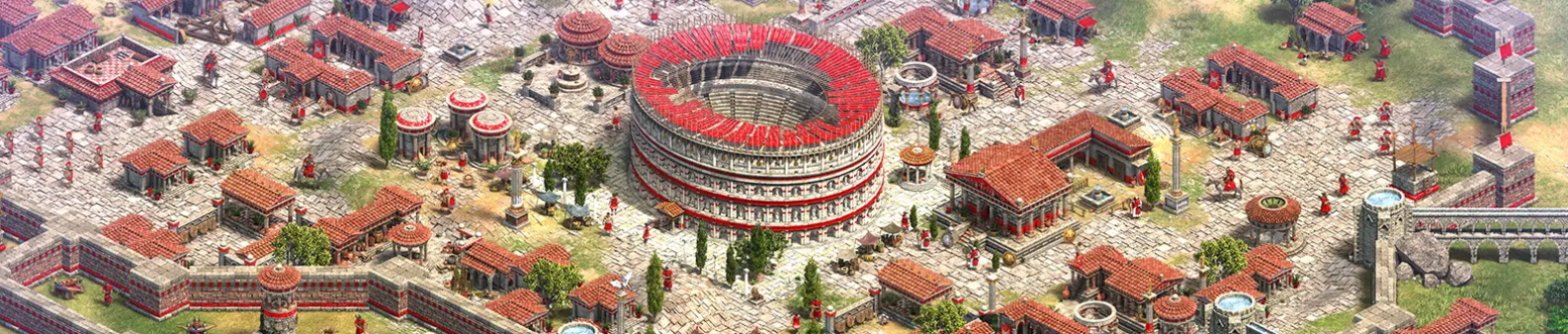
The popularity of video games has grown exponentially since the days of LAN parties and CoD MW Xbox Live lobbies. Gaming has developed into its own language alongside online communities and cultures. This language has even bled into the highest echelons of government; the social media branch of the current administration has used game franchises to promote recruitment into ICE by comparing immigrants to the alien Flood in Halo and to hype up the current war in Iran by splicing in-game footage from Call of Duty with live footage of missiles and airstrikes. This wider interlacing of games within the modern cultural fabric, an increasing use of game franchises in other forms of media, a broadening of game development and demographics, and the continued usage of antiquity as a source of inspiration means many of our students encounter the ancient world digitally. It also means that there is plenty of organic interest and material available to instructors curious about bringing games into classrooms. For this blog post, I want to talk about the challenges of designing a full course on the subject, “The Ancient World in Video Games,” alongside presenting resources for those who may want to introduce games for a session within a course on the ancient world.

Before starting, however, I want to make it explicit that this is not for every instructor. It is not a miracle cure for declining enrollments or some sort of technological innovation that we must incorporate or risk lagging behind the way that other technologies are being recklessly and aggressively advertised. Games do, however, offer another angle of approach to stoke interest in students and can be treated with the same academic acuity with which we treat other forms of media to survey and scrutinize our ever-changing relationship with antiquity. Moreover, the ancient world has been a fertile field for game development since its earliest days. Mabel Addis, a fourth-grade teacher in New York, is largely credited as the first video game writer, the inventor of the strategy genre, and a pioneer in computer games when she collaborated with IBM programmers to develop The Sumerian Game in 1964; the game tasks the player with running the city of Lagash through a variety of scenarios intended to educate on subjects like math, agriculture, and trade. It is the recognition of the history of game design alongside recognition of games as a unique, interactive medium that allows for rewarding examination of the intertwined relationship between antiquity and modern media.
Titled “The Ancient World in Video Games,” the course offers an opportunity to view games both as objects of receptions and as a medium wherein historical and archaeological questions that affect our physical histories are negotiated within the immaterial, digital space. Think, for instance, of the underlying considerations in The Sumerian Game to render the running of an ancient city as gameplay. What would you as a designer want to include? Food, housing, economies, industries, social classes? How would you construct gameplay around these concepts? What is the narrative you are trying to build in the game and how does it reflect narratives about early urbanism? In effect, game design and play, while obviously not wholly analogous, can meaningfully engage with questions asked by historians, archaeologists, and classicists.
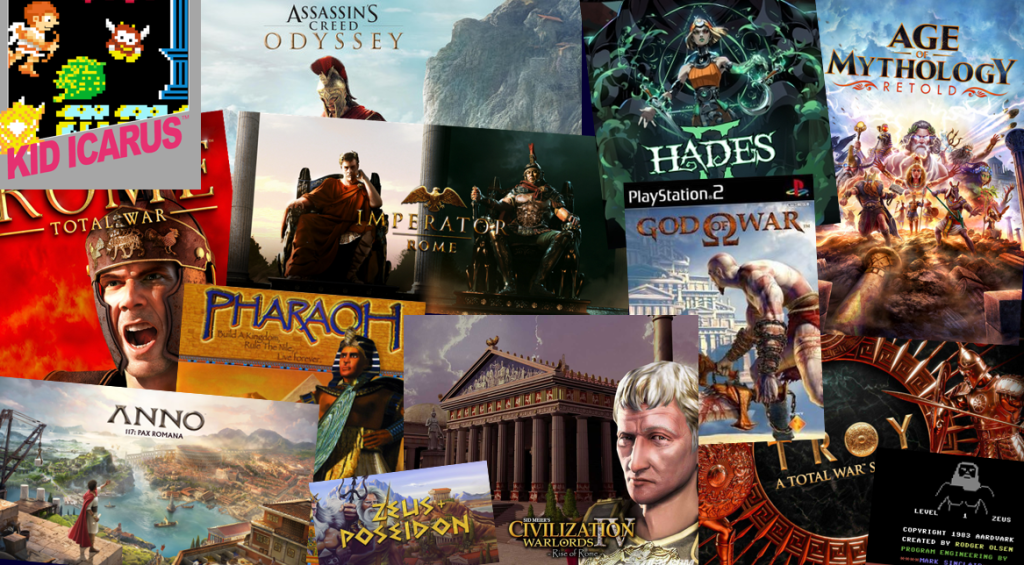
The class meets twice a week with each week dedicated to a particular theme (i.e., violence, urbanism, religion and mythology, monsters). The Tuesday session focuses on the historical segment and the Thursday class focuses on the translation of these historical, archaeological problems onto digital objects and worlds. This was influenced by the monograph of Andrew Reinhard, Archaeogaming, wherein we can both trace the impact that our material culture has had on the design of fictive worlds and also implement real world archaeological practices onto these worlds. Similarly, it is influenced by Jeremiah McCall’s Gaming the Past which provides a framework to explore games as historical problem spaces. So far, the class has drawn a composite group, skewing more towards STEM than Humanities majors, drawn, I am sure, by the novelty of a course title with “video games” in it and the emphasis on digital technologies.
There are some challenges due to this student variety and due to the medium itself. First, I have to bring everyone up to a conversational level on History, Archaeology, and the general chronology of the ancient Mediterranean. This is nothing new for similar lower-level thematic courses aimed at undergraduates. The largest hurdle was accessibility to the games discussed. Are students expected to play all these games? Are they expected to purchase them? Some are not cheap and, even if they are, you still need a console or computer. There is no singular answer to this. Gameplay of almost any game is available on YouTube and game manuals are uploaded in comprehensive wikis, serving as imperfect, sure, but nevertheless viable ways to study games and their mechanics in depth (in the case of the wikis, they are also riddled with code and statistics often hidden to players). My colleagues in Game Studies and Design and the staff at Instructional Computing Services (ICS) have helped as well and we have five dedicated computers in one of the campus labs with our games installed on a shared account. Students can visit the lab during open hours and play several games mentioned in class alongside in-class playthroughs led by me.
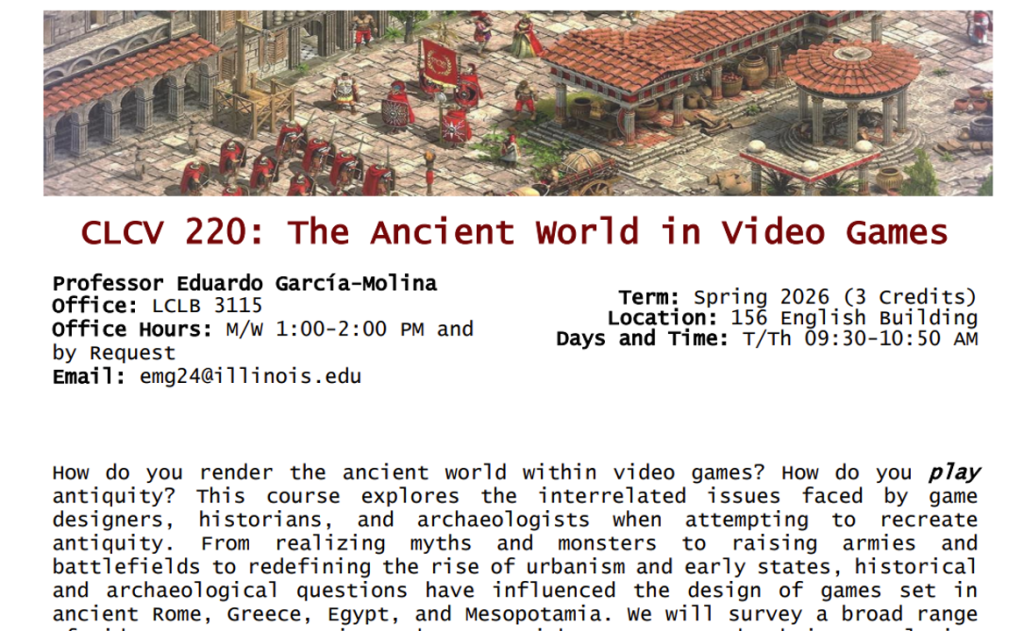
Finally, how then do you assess students? Alongside weekly journals asking students to go out and deconstruct games based on the themes of the week (i.e., urbanism as play), there is the final capstone project that asks them to develop a game pitch, a hypothetical proposal of a game or VR experience concept. This serves as both a creative writing assignment intended to get students thinking about video games as a designer and a scholarly exercise in considering our historical and archeological evidence and their transmission into visuals, audio design, and mechanics. To do so, I made the pitch an oral presentation followed by a short, written portion. The former serves as the more creative element while the latter lets students be more explicit about any hurdles they encountered as they researched the settings of their games. What do students end up doing?
One who was interested in textiles and the Achaemenid Empire pitched a game titled “Silks of the Shah” where you play as an apprentice tailor and try to build a successful business while visiting the different regions of the Achaemenid Empire. The ultimate goal is to become the clothier of Darius I himself. The student used known satrapies to design stages for the game, with progression being locked until the player finishes a particular region by making the most of its natural resources and fashion trends. For instance, the satrapy that includes Phoenicia might have textiles that incorporate more purple to reflect the historical production of the color from the local murex snail species. They articulated in their paper their encounters with material evidence for their example satrapies and the difficulties in reading Achaemenid material culture through imperial iconography. Another student pitched “Oracles of Delphi,” which promised a narrative aimed at teasing out the agency of the Pythia, who is often referenced in our sources, but whose personal narrative is never explored. The student wanted to address this lack of perspective by putting the player in Pythia’s shoes, taking the player through the divination ceremony before having the player explore the sanctuary for clues to decipher the visions they receive. They noted in their written portion that this decoding of visions was meant to replicate the notoriously double-edged, vague nature of Delphic prophecies. The subsequent answers to these visions could then have ramifications for the polities and influential figures throughout Greek history that visited Delphi and the player encounters. Such projects exhibit how considering the element of play and ludic narrative-building can goad us into thinking deeper about lost evidence and diverse perspectives beyond what is found in the literary, historical, and archeological record.
To sum up, there are multiple reasons why games can aid in bridging the gap between our students and antiquity. From the inherent appeal they possess among younger generations to the interactive elements that, especially when it comes to designing games, reveal the difficulties in our evidence. I realize this is not for everyone, and I am not claiming that this should be some sort of pedagogical revolution. However, if you are curious about this work, either as an instructor or researcher, I can offer encouragement and some initial resources that can aid in scaffolding a class on topics in ancient history and Latin. This is a fruitful field that incorporates longstanding aspects of digital humanities and these resources that I have compiled, though by no means exhaustive, offer some examples of scholarship, games, resources for a broad audience of players. Included are even some games that are designed to teach players of varying ages about numismatics and epigraphy. I especially want to point out that Danger in Pompeii, a game developed by students, teachers, and designers in Switzerland for younger audiences, has an invitation on their game page for instructors to request classroom copies and additional resources.
While not everyone needs to embrace games as a possible tool for pedagogy and accessibility, games should not be dismissed, as has been my personal experience with colleagues in the field. Some come from a lack of familiarity, some comes a dismissal of the medium as base compared to, say, a play. Regardless of personal feelings towards the subject and the frequent charge of elitism in the field, it is evident games are not going away anytime soon. Moreover, the medium itself can stoke interdisciplinary collaboration between scholars and designers; this is especially salient given broader trends in digital humanities and museum studies that have seen the digitization of collections. This is all to say that games offer one avenue out of many to consider for increasing engagement with the ancient world and their popularity and subsequent impact on online culture has ensured that they will continue to contribute, for better and for worse, to the dissemination of the ancient world among modern audiences.
General Resources
Paizomen: A Database of Classical Antiquity Games
Description: A database created by a leading scholar studying games in antiquity, Alexander Vandewalle. It is the most comprehensive online database of games revolving around Greek and Roman antiquity. It has proven useful for research, but also for giving students a database if they are unfamiliar with older titles.
Save Ancient Studies Alliance (SASA) Archaeogaming Class Modules
Description: Free, expert-curated classroom resources that use popular video games like Assassin’s Creed and Pharaoh to teach students about the ancient world. Each module features a specialized educational video paired with a comprehensive lesson pack containing activities, quizzes, and scholarly primary sources designed for K-12 learners.
Description: Gaming the Past is a comprehensive resource hub created by historian and educator Jeremiah McCall, dedicated to the integration of historical video games into the classroom. The site provides a wealth of practical tools for teachers, including pedagogical frameworks like the “Historical Problem Space,” curated lists of historically relevant games, and sample lesson plans for secondary and higher education.
Researcher-led Let’s Plays
Description: Magister Craft is an educational platform by Jessie Craft that offers a library of immersive videos rendered in Minecraft and lesson materials designed around the study of Latin and ancient history.
ASCSA Assassin’s Creed: Odyssey Walkthrough with John Camp
Description: A collaboration between Ubisoft and the American School of Classical Studies at Athens using Assassin’s Creed: Odyssey to provide a detailed virtual tour of ancient Olympia.
Class-Friendly Games
Description: A game developed by the University of Tübingen that utilizes a 3D “endless runner” format to teach young students about the historical significance of ancient coins.
Description: An educational adventure-puzzle game that features a unique comic-book art style and explores authentic Roman daily life in Pompeii in the backdrop of deciphering the “mystery of Mercury.” Free classroom version also advertised, can contact developers.
Description: A multimedia project undertaken by the Universidad de Navarra to digitize their Roman inscriptions and create public scholarship initiative that features a digitized corpus of inscribed objects, a documentary, and the game Valete Vos Viatores that aims to teach how Roman inscriptions were made by stonecutters.
Minecraft Archaeology Adventure
Description: An educational experience for Minecraft: Education Edition that immerses students in a digital excavation of Melbourne’s Metro Tunnel site. Developed alongside archaeologists, players use specialized tools to uncover and document artifacts that tell the story of the city’s colonial and pre-colonial past. Minecraft: Education Edition has several scenarios, including a walkthrough of several ancient cities, including Rome, and activity packets and maps for Ancient Egypt.
Bibliography for Game Studies
Clare, R. 2022. Ancient Greece and Rome in Videogames : Representation, Play, Transmedia. Bloomsbury Academic.
Draycott, J. and Cook, K. (eds.) 2022. Women in Classical Video Games. Bloomsbury Academic.
Karabinus, A., Kocurek, C. A., Mejeur, C., and Vossen, E. (eds.) 2025. Historiographies of Game Studies : What It Has Been, What It Could Be. Punctum Books.
McCall, J. B. 2023. Gaming the Past : Using Video Games to Teach Secondary History. Routledge.
Reinhard, A. 2019. Archaeogaming : An Introduction to Archaeology in and of Video Games. Berghahn Books.
Vandewalle, A. Forthcoming (May 2026). Characters and Characterization in Mythological Video Games. Bloomsbury Academic.

Eduardo García-Molina (Ph.D. University of Chicago) is an Assistant Professor of Classics at the University of Illinois Urbana-Champaign. He is an Ancient Historian specializing in the Seleukid Empire. His research interests include the interrelated development of imperial bureaucracy and ideology, the role of documents and archives in the experience of ancient empires, and the role that said documentary media had in the development of Hellenistic law.
Alongside his ancient research, he is also interested in the reception and translation of ancient history within video games. He has published and presented on multiple aspects, from the gamification of ancient states and religions to the material culture and epigraphy of games.
Like our content? Consider donating to Peopling the Past. 100% of all proceeds support honoraria to pay the graduate students and contingent scholars who contribute to the project.
Make a monthly donation
Make a yearly donation
Choose an amount
Or enter a custom amount
Your contribution is appreciated. Please note that we cannot provide tax receipts, as we are not a registered charity.
Your contribution is appreciated. Please note that we cannot provide tax receipts, as we are not a registered charity.
Your contribution is appreciated. Please note that we cannot provide tax receipts, as we are not a registered charity.
DonateDonate monthlyDonate yearly Peopling the Past