
The Peopling the Past team will be running a colloquium session at the upcoming Archaeological Institute of America Annual Meeting in Philadelphia. We’ll be celebrating the release of our upcoming open-access volume edited by Chelsea Gardner and Sabrina Higgins, Ancient Pasts for Modern Audiences: Public Scholarship and the Mediterranean World. This volume brings together a diverse range of voices to highlight inclusive methods of knowledge mobilization and communication of scholarship on the ancient world to public audiences. The Philadelphia colloquium will include several volume contributors presenting on ethical curatorial and educational practices. The colloquium description and abstracts are below.
This is a hybrid session. For those attending in person, we are Session 3C. For those attending virtually, the Archaeological Institute of America is using a secure online platform (more info on both methods of attendance can be found on this page).
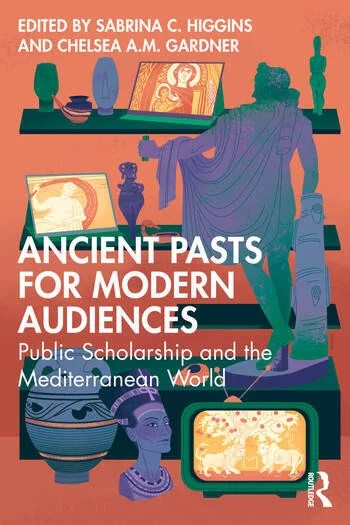
Ancient Pasts for Modern Audiences: Rethinking Public Scholarship and Pedagogy on the Ancient Mediterranean
AIA/SCS Colloquium
Moderator/Chair: Chelsea A.M. Gardner
A common critique of the study of ancient history is that it is “institutional and exclusionary; still the stuff of galleries, museums and UNESCO World Heritage sites; of prized images, objects and structures, rather than of living humanity” (Wengrow 2018). This critique speaks to the multiple peoples and experiences in the past that are overlooked. It also speaks to people in the modern world who are excluded from institutions and discourses surrounding human history. Public scholarship addresses the latter by breaking down barriers between the academy and the broader public, improving inclusion and diversity and providing additional social benefits. But the fields of ancient Mediterranean, West Asian, and North African history and archaeology remain deeply entangled with racist and exclusionary agendas which have impacted how scholars communicate knowledge about this history (Rankine 2019; Eccleston and Padilla Peralta 2022). In an age where social media and digital technology have increasingly reduced barriers between the academy and the public, how can we as educators effectively participate in public and pedagogical discourse about the past? How do we engage in responsible scholarship that is more inclusive of past diversity and modern audiences?
The proposed colloquium addresses these questions by bringing together contributors to the forthcoming volume, Ancient Pasts for Modern Audiences (edited by C.A.M. Gardner and S.C. Higgins, Routledge), to discuss the challenges and best practices for public scholarship on the history and archaeology of the ancient Mediterranean, West Asia, and North Africa. Speakers will address responsible approaches to public scholarship, focusing on two areas, namely classroom pedagogy and museum spaces. All papers explore how we can responsibly engage and communicate with academic and non-academic audiences across these various learning environments in ways that break down the exclusionary tendencies of the field. The papers also address questions of positionality, voice, and representation in knowledge production, the ethical treatment of cultural heritage, and accessibility and inclusivity in public resources in the new digital and public realities of the twenty-first century.
The first paper, Introducing Ancient Pasts for Modern Audiences, presents the volume’s three areas of investigation for public discourse – classrooms, museums, and digital/public scholarship – and outlines a working agenda for the field of ancient Mediterranean studies for producing responsible scholarship. The next two papers centre on museum display practices. The Unwavering Divide interrogates colonial rhetorics that continue to influence how objects from African regions are classified and displayed in museums. It suggests new perspectives and methods to extract museum practices from these rhetorics, including new ways of classification and expanding on the objects’ historical contexts in display collections. Densities of Provenancing examines the provenance history of the Bay View Association’s Egyptian collection at the Kelsey Museum of Archaeology. It applies approaches from Critical Indigenous Studies to expand the discourses of provenancing to focus on relational ties between collections, collectors, and stakeholders, animating objects within their communities of origin and collection. The last two papers focus on pedagogy. Teaching the Ancient World with Reproductions presents the results of a research project focused on the use of 3D printed reproductions in the classroom. This project seeks to foster authentic active learning experiences, recenter human beings in antiquity, and enhance classroom conversations about digital technologies, cultural heritage, restitution, and rights of access. The Peopling the Past Project outlines the development and design of educational resources by the collaborative digital humanities initiative, Peopling the Past. These classroom resources centre on rich format media that promotes multivocal approaches from diverse practitioners in the field. Such resources allow instructors to develop student-centred learning experiences where students can actively and critically engage with peoples and histories of the ancient Mediterranean world, while engaging more directly with the diverse peoples who study these pasts in the modern world. Following these papers, all presenters will then engage in a panel discussion moderated by discussant Chelsea A.M. Gardner and an open question-and-answer period with the audience.
Presenters
Title: Introducing Ancient Pasts for Modern Audiences: Considering Paths Forward for Public Scholarship and Pedagogy in the 21st Century
Authors: Chelsea A.M. Gardner (Acadia) and Sabrina C. Higgins (SFU)
Abstract: In this paper, we introduce the audience to our forthcoming edited volume, entitled Ancient Pasts for Modern Audiences: Public Scholarship and the Mediterranean World, which considers the ways in which scholars and practitioners working within the fields of ancient Mediterranean, West Asian, and North African history and archaeology can promote and create inclusive, decolonial, and critical methods of knowledge mobilization and communication across various public spheres. Following the lines of inquiry within the volume, this introductory paper prioritises three distinct areas of public engagement in its discussion, notably, museums and cultural heritage, pedagogy, and public-facing scholarship, all of which have been directly affected by Eurocentric structures that have claimed ownership of ancient Mediterranean cultural heritage and have dictated how it was taught in schools and communicated to a broader public. By bringing the chapters published in this volume into close conversation, we highlight the most pressing challenges identified by practitioners working within these distinct fields, offer pathways to overcome the exclusionary narratives that plague our respective fields, and highlight the tangible ways in which scholars can contribute to responsible and critical scholarship within their own public-facing work.
—
Title: The Unwavering Divide: Collection and Display Practices of Ancient and Medieval African Collections
Author: Annissa Malvoisin (Bard Graduate Center)
Abstract: This chapter investigates the dichotomy of ancient and medieval African collections in museums whereby their division in departments tend to flow into and influence interpretive models of curation. Through analyses of the histories of these collections, how they came to be departmentally organised, and how objects from African regions were classified, I consider the colonial rhetoric that has settled into curatorial practice in collecting institutions. This rhetoric has consequences on the production of knowledge in cultural institutions meant to serve the public. This chapter actively acknowledges the colonial bias embedded in the knowledge structures of studying and curating African material culture and presents new ways of seeing through decolonial approaches to working with these cultural collections in museums, such as reconsidering classification methods and expanding the presentation of objects’ historical contexts.
—
Title: Densities of Provenancing: Narrating the Colonial Provenance of the Bay View Collection at the Kelsey Museum
Author: Ashton Rodgers (Mvskoke), University of Michigan (Interdepartmental Program in Ancient Mediterranean Art and Archeology)
Abstract: With the intent to engage alternative pathways in public scholarship, this paper investigates the relationships between provenance narratives, ancient Mediterranean collections, colonization, and Indigenous research perspectives. It explores the provenance of the Bay View Association’s (BVA) Egyptian collection at the Kelsey Museum of Archeology in the context of its historical involvement in colonization in Egypt and North America. The aim of this paper is to expand the scope of reflection around questions of provenance narrative writing from an Indigenous research perspective. I consider both the ways that the BVA collection is involved in a plurality of colonizations and the new directions that methodologies from Critical Indigenous Studies (CIS) offer for provenance storying with collections from entangled colonial contexts. CIS methodologies radically expand both practices and discourses of provenancing by de-centering concepts of property in museum narratives and instead centering relational networks between collectors and collections, given their historical contexts. By engaging Indigenous methodologies as a framework, I retell the story of the Egyptian collection with a critical emphasis on the collection’ s context within colonization in Egypt and Michigan, including dispossession policies and colonial schools. This shift sees provenance narratives as more than documentary research, but narratives for and by people and communities. As a result, in this paper the provenance of cultural belongings and ancestral remains is not defined by legal ownership, but by their lives in their communities of origin and collection, as well as their relationship to colonialism and dispossession.
—
Title: Teaching the Ancient World with Reproductions: 3D Printed Objects and Authentic Active Learning
Authors: Christine L. Johnston (WWU), Alan Wheeler (WWU), Alexis Nunn (WWU), and Erin Escobar (WWU)
Abstract: This paper presents the results of a research project focused on the use of 3D printed reproductions in introductory courses on the histories and cultures of the ancient Mediterranean, West Asia, and North Africa. The goal of this project was to assess the efficacy of using digital reproductions in classroom activities with the aim of fostering significant student learning through authentic active learning experiences and enhanced course accessibility, including for students with visual impairments. Objects were incorporated into daily lectures and class discussions in order to serve different modes of learning and were employed in learning modules that gave students the opportunity to apply historical and archaeological methods in the classroom. The materials incorporated focused on objects of every-day life, recentering human beings in antiquity, while providing students with the opportunity to engage with reproductions of objects predominantly housed in elite overseas institutions. The assessment of these digital reproductions also enhanced important conversations about digital technologies and cultural heritage, especially around avenues of restitution and rights of access.
Three teaching modules were designed by the project on the decipherment of ancient scripts and texts; the study of Greco-Roman coins; and cultural heritage, museum holdings, and restitution. Following the design phase, we then tested the pedagogical efficacy of these object-based learning modules through in-class research using qualitative methods (specifically student surveys). The paper will present the recently-designed third module on cultural heritage, as well as the results of the in-class testing of the first two modules (the writing and numismatics modules) across five courses that ran between Winter 2020 and Spring 2023.
—
Title: The Peopling the Past Project: Multivocality and Multimodality in Ancient Mediterranean Studies Teaching
Authors: Megan J. Daniels (UBC), Christine L. Johnston (WWU), Sabrina C. Higgins (SFU), Victoria Austen (UIUC)
Abstract: This paper outlines the development and design of educational resources by the Peopling the Past (PtP) project that address continuing Eurocentric legacies and metanarratives in history, archaeology, and classics. PtP is a collaborative digital humanities initiative that produces and hosts open-access multimedia resources for teaching and learning about people in the ancient Mediterranean, West Asian, and North African worlds. As recent studies have shown, scholarship and teaching in these areas remains deeply entangled with racist and exclusionary agendas that masquerade as detached from the lived experiences of its participants. To address these legacies, the goals of PtP center on creating resources that highlight real people and experiences in the past along with the diversity of modern scholars who study these pasts. PtP Project resources include blogs, videos, and a podcast, which can be integrated into relevant courses to promote authentic and significant learning. This paper will present each component of PtP’s resources, analyzed through the lenses of learning science. Learning science research demonstrates that student engagement can be enriched through the use of media that target different modalities of learning, particularly interactive tools and rich-format content; learning is further enhanced by the integration of media presenting the work of numerous specialists, broadening the voices and perspectives presented to students. This multivocality is critical for fostering inclusive learning of past peoples and present-day knowledge producers. This paper will outline some specific examples of how PtP resources have been incorporated into course content and general comments on student experiences with these learning resources. Overall, by promoting multivocality and multimodality, the teaching media produced by PtP can be used by instructors to develop student-centered constructivist learning experiences that provide opportunities for significant learning and for students to engage more deeply with peoples and histories that are chronologically and geographically distant.
 Peopling the Past