For Halloween in 2026 we are exploring the scary things in Homer’s (and sometimes Nolan’s!) Odyssey. Our writers investigate how the monstrous and mysterious are narrated, adapted, and situated in both ancient and modern societies through the many iterations of this wondrous tale. What are the deeper meanings of these characters and scenes, and why do they continue to captivate us into the twenty-first century?
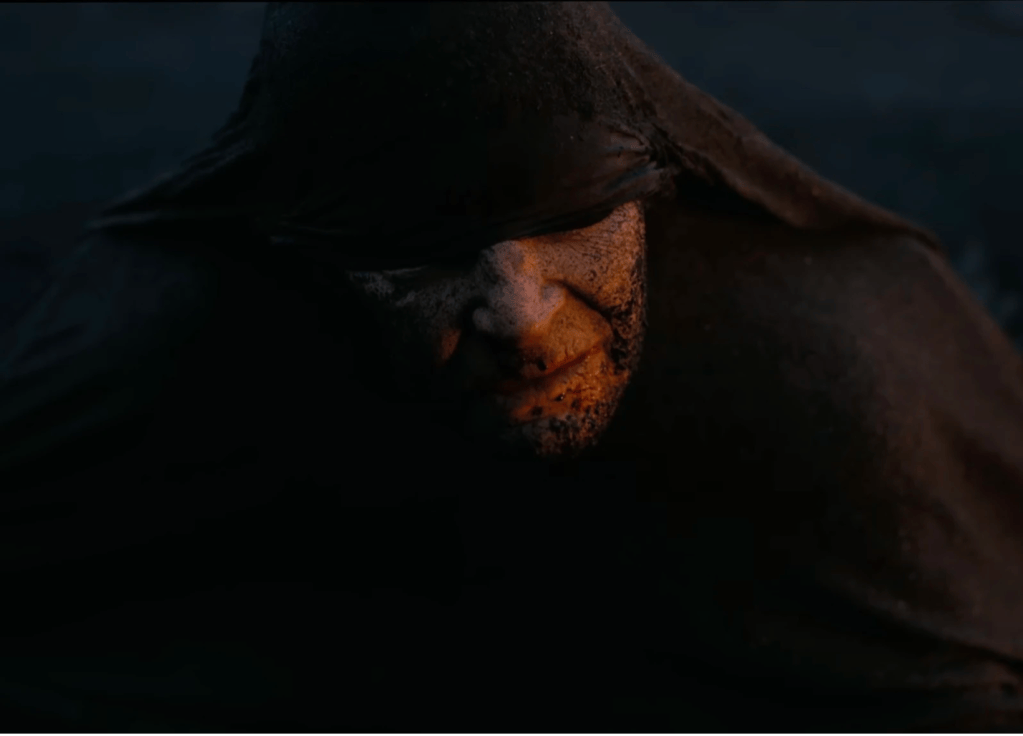
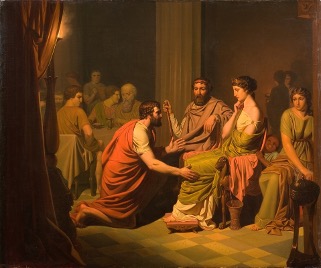
One of the most remarkable features of Christopher Nolan’s recent 2026 filmic Odyssey is the chilling scene in which Odysseus summons the spirits of the dead. This frightful spectacle generally tracks with its ancestor in Homer’s Odyssey book 11: Circe instructs Odysseus and his men to “head north in the twilight” and “head inland until a river of fire meets a river of ice,” where he must dig a trench and “fill it with the blood of sacrifice to gather the dead” so Odysseus can ask the dead seer Tiresias for the way home to Ithaca. (Nota bene: Homer’s sacrificial pit concoction is much more elaborate— way to skimp, Nolan, on the budget for milk, honey, wine, and barley.) Suddenly and terrifyingly, the dead claw their way up from beneath the black sand and shuffle uncannily towards the pit of blood. Odysseus has three short conversations with shades, including Tiresias; then, as in Homer, the shades—like a relentless swarm of Hollywood zombies—become agitated and rush towards Odysseus and his men, putting the frightened mortals to flight back to their ship.
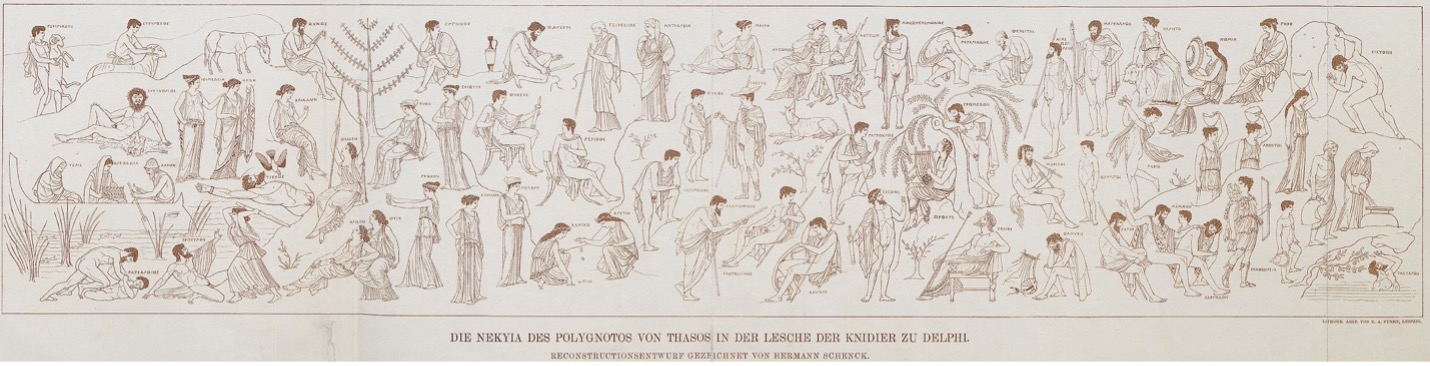
Nolan thereby gives us perhaps the best existing cinematic representation of the Homeric Nekyia, Odysseus’ summoning of and conversation with the dead. Indeed, the spellbinding horror of this scene—along with the film’s much-discussed Cyclops and Circe sequences—leads one to wonder when Nolan will finally give himself permission to make a proper horror film. After all, in the Odyssey as in elsewhere in his oeuvre, Nolan is fascinated with the precariousness and mutability of memory, of civil order, and of human life. And what is horror (as Jesse Weiner, Ben Stevens, and I recently suggested) other than the genre par excellence concerned with “real violence that awaits precarious bodies”? Nevertheless, there are some crucial differences between Nolan’s nekyia and the Homeric version, and these differences reveal other important things about how conversations with dead people work. In Nolan’s version, Odysseus has mostly brief conversations with Sinon (about whose death Odysseus feels guilt), Agamemnon (who narrates his own deadly homecoming), and Tiresias (who narrates the perilous way home). But in Odyssey book 11, Odysseus converses with his recently deceased comrade Elpenor, Tiresias (who only describes what to do after returning to Ithaca), his mother Anticleia, Agamemnon, the hero Achilles, and the phantom of Heracles, as well as a failed attempt to converse with the hero Telemonian Ajax. Odysseus also describes seeing a host of other (in)famous mythic figures, including a long catalogue of mythic heroines, Minos judging the dead, and several mortals facing eternal punishment. While Nolan’s nekyia is essentially “Interview with Three Revenants,” Homer’s version is crowded with famous figures, a mash up of the final scene of George Romero’s
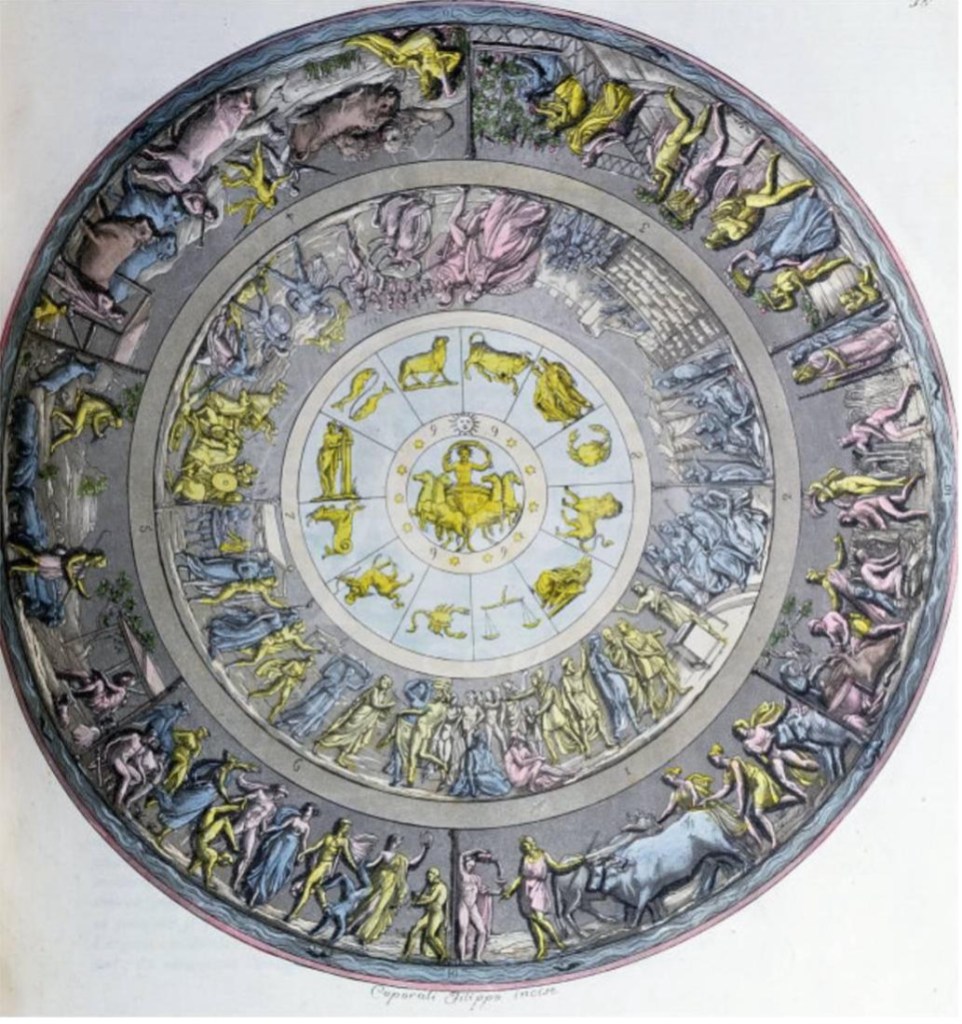
Subsequently, it is tempting to suggest that the Homeric Nekyia is the Odyssey’s response to the Iliad’s famous Shield of Achilles. In Iliad book 18, the god Hephaestus manufactures a shield for Achilles on which there is a similarly busy, populated world: the cosmos, a city of marriages and festivals, a city at war, tilled lands, vineyards with wine, and so forth. Both the Shield of Achilles and the Nekyia positively hum with activity. However, whereas the Shield of Achilles seems to catalogue the non-violent world that Achilles is missing by virtue of his choice to fight and die at Troy, the Nekyia catalogues the heroic world that Odysseus has already missed. This motley host of shades in the Nekyia has the effect of making Odysseus—the last hero to make it home from Troy and to complete his nostos (‘homecoming’)—look like the end of an age, the end of the party. Indeed, the Homerist Richard Martin has referred to the Odyssey as “the last hero song.”
While all these shades and lumbering corpses might suggest to us rot, decay, intangible loss, and a glorious past long gone, there’s nevertheless a ray of sunlight—or, perhaps better, a comforting shade—to be found in all of this. One of Nolan’s most interesting omissions from his filmic Odyssey is Odysseus’ meeting with the wondrous Phaeacians, an island people whose lives are characterized by peace and naval prosperity, cyber-dogs and self-steering ships. (Nolan’s entire film seems committed to the elimination of any true sense of wonder from the Odyssey.) In Homer’s Odyssey, it is the Phaeacians who are the audience for Odysseus’ spooky tale of the Nekyia. So while the content of the Nekyia points to a world gone by, Odysseus’ conversations with dead people are also the means by which he converses and connects with the very-much-alive Phaeacians. Indeed, one might argue that the most notable feature of book 11 is not the Nekyia, but the strange interruption in the middle (sometimes referred to as the ‘intermezzo’): after narrating the catalogue of spectral heroines, Odysseus basically says “But it’s late. I’m going to stop now”; we, the audience are brought abruptly back into the present moment of the narrative, Odysseus sitting in a darkened hall telling a story among a rapt audience of Phaeacians.
Odysseus seems to use this ghost story to communicate subtly with his greatest ally in the room, the Phaeacian queen Aretê, who was the first member of the royal court to receive him officially as a guest seeking shelter. In narrating the long catalogue of heroines, Odysseus seems to speak to Aretê directly and say “I see you, too: there is something for everyone in my story.” In the dialogue that follows, Aretê once again acts as a booster for Odysseus, and the Phaeacian king Alcinous once again concedes to her will, promising Odysseus even greater rewards and encouraging Odysseus to continue his story. So while we may be like Nolan and fixate on the ghastly horror of the Homeric Nekyia or ache with feelings of nostalgia for a world now past, Homer’s book 11 suggests that our conversations with the dead are very much about our relationships with the living sitting right in front of us.
Additional Resources
Gazis, George Alexander. 2018. Homer and the Poetics of Hades. Oxford: Oxford University Press.
Hunter, Richard and Rebecca Laemmle, eds. 2026. Homer: Odyssey Book XI. Cambridge: Cambridge University Press.
Lye, Suzanne. 2024. Life/Afterlife: Revolution and Reflection in the Ancient Greek Underworld from Homer to Lucian. Oxford: Oxford University Press.
Martin, Richard P. 1993. “Telemachus and the Last Hero Song.” Colby Quarterly 29.3.222-240.
Most, Glenn W. 1992. “Il poeta nell’Ade: catabasi epica e teoria dell’epos tra Omero e Virgilio.” Studi Italiani di Filologia Classica. Series 3. 10.2.1014-1026.
Nolan, Christopher. 2026. The Odyssey: The Screenplay. Faber.
Rogers, Brett M. 2024. “Cyber-Dogs, ‘Gut Thinkings’, and the Limits of Recognition in Homer’s Odyssey.” In Artificial Intelligence in Greek and Roman Epic. Ed. Andriana Domouzi and Silvio Bär. London: Bloomsbury Academic. 47–58.
Rogers, Brett M. 2026. “2001 Space Odysseys: Teaching Homer’s Odyssey with Pop Culture.” In Approaches to Teaching Homer’s Odyssey. Ed. Lillian E. Doherty. New York, NY: The Modern Language Association of America. 156-166.
Stevens, Benjamin Eldon, Jesse Weiner, and Brett M. Rogers. 2024. “Classical Monsters in Speculative Fiction.” In Oxford Handbook of Classical Monsters. Ed. Debbie Felton. Oxford: Oxford University Press. 541–557.
Tsagarakis, Odysseus. 2000. Studies in Odyssey 11. Hermes-Einzelschriften Vol. 82. Stuttgart.
Brett M Rogers is professor and chair of Greek, Latin, and Ancient Mediterranean Studies at the University of Puget Sound. His research interests include Greek epic and drama, and the reception of antiquity in modern media and popular culture. He has co-edited four volumes on classical receptions in science fiction and modern fantasy, including Classical Traditions in Science Fiction (2015), Classical Traditions in Modern Fantasy (2017), Frankenstein and Its Classics (2018), and Once and Future Antiquities in Science Fiction and Fantasy (2019). More recent publications include essays on cyber-dogs in Homer’s Odyssey, classical monsters in speculative fiction, and using Christopher Nolan’s Odyssey in the classroom. He is currently working on a book on Classical Cascadia: Receptions of Mediterranean Antiquity in the Pacific Northwest.
Like our content? Consider donating to Peopling the Past. 100% of all proceeds support honoraria to pay the graduate students and contingent scholars who contribute to the project.
Make a monthly donation
Make a yearly donation
Choose an amount
Or enter a custom amount
Your contribution is appreciated. Please note that we cannot provide tax receipts, as we are not a registered charity.
Your contribution is appreciated. Please note that we cannot provide tax receipts, as we are not a registered charity.
Your contribution is appreciated. Please note that we cannot provide tax receipts, as we are not a registered charity.

