For Halloween in 2026 we are exploring the scary things in Homer’s (and sometimes Nolan’s!) Odyssey. Our writers investigate how the monstrous and mysterious are narrated, adapted, and situated in both ancient and modern societies through the many iterations of this wondrous tale. What are the deeper meanings of these characters and scenes, and why do they continue to captivate us into the twenty-first century?
The persona of a powerful foreign sorceress loomed large in the Greek imagination as a figure to be distrusted. Such women posed a perceived threat to the established social order in that they possessed special knowledge that could overpower men, they were often sexually liberated, or they deviated in other ways from the restricted roles that women held in Greek society. In short, they represented a sense of untamed otherness. Throughout the Odyssey, the titular hero’s encounters with witches, sorceresses, and monsters, who at turns deter and help his progress, in many ways reflect the ambivalent relationship ancient Greeks had with ideas of magic.
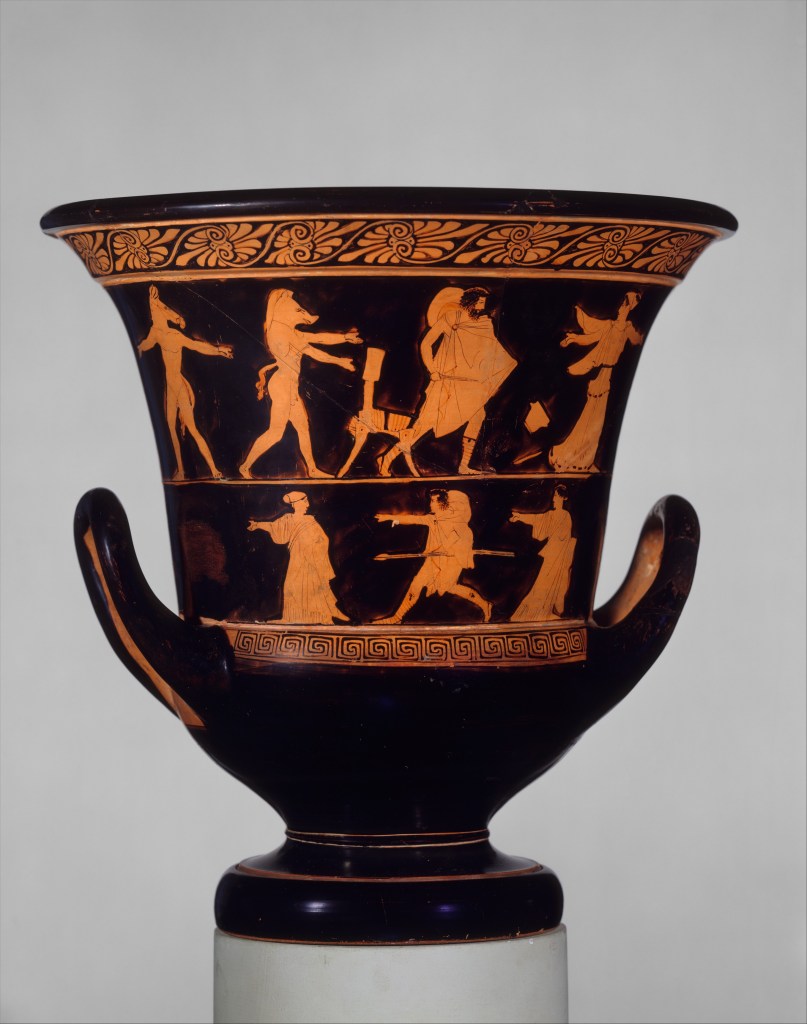
One of the most famous witches of Greek myth is Circe, whose mastery of magical potions and herbal remedies is on full display in her appearance in the Odyssey, the key episode from which is represented on a red-figure calyx-krater currently on view in the exhibition Cursed! The Power of Magic in the Ancient World at the Institute for the Study of the Ancient World in New York.
Circe’s story has already appeared in this month’s blog post series, where Liv Albert brings the character to life. To quickly summarize, in Book 10 of the epic Odysseus and his men land on Circe’s island, Aeaea, and are drawn to her home in the woods, which is guarded by wolves and lions whom she has domesticated with spells. Lovely Circe welcomes the men in and feeds them a potion mixing barley, cheese, honey, and wine together with drugs. The men are transformed into swine and Circe locks them in a pigsty. One of Odysseus’ companions escapes and flees back to shore to beg Odysseus for help. Odysseus approaches Circe’s home, armed with instructions and an herbal antidote he has been given by the god Hermes. Odysseus is a powerful and clever man but even he needs help to counteract ancient magic: he has to ask for secret knowledge from the gods regarding the correct sequence of words to speak and actions to perform.
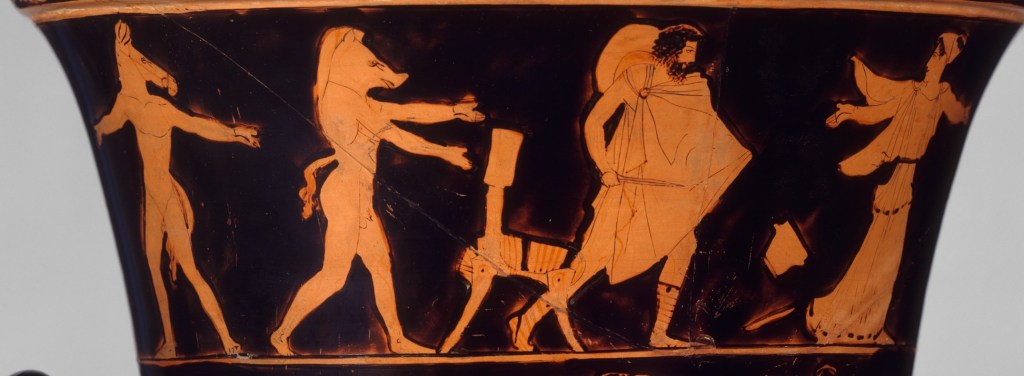
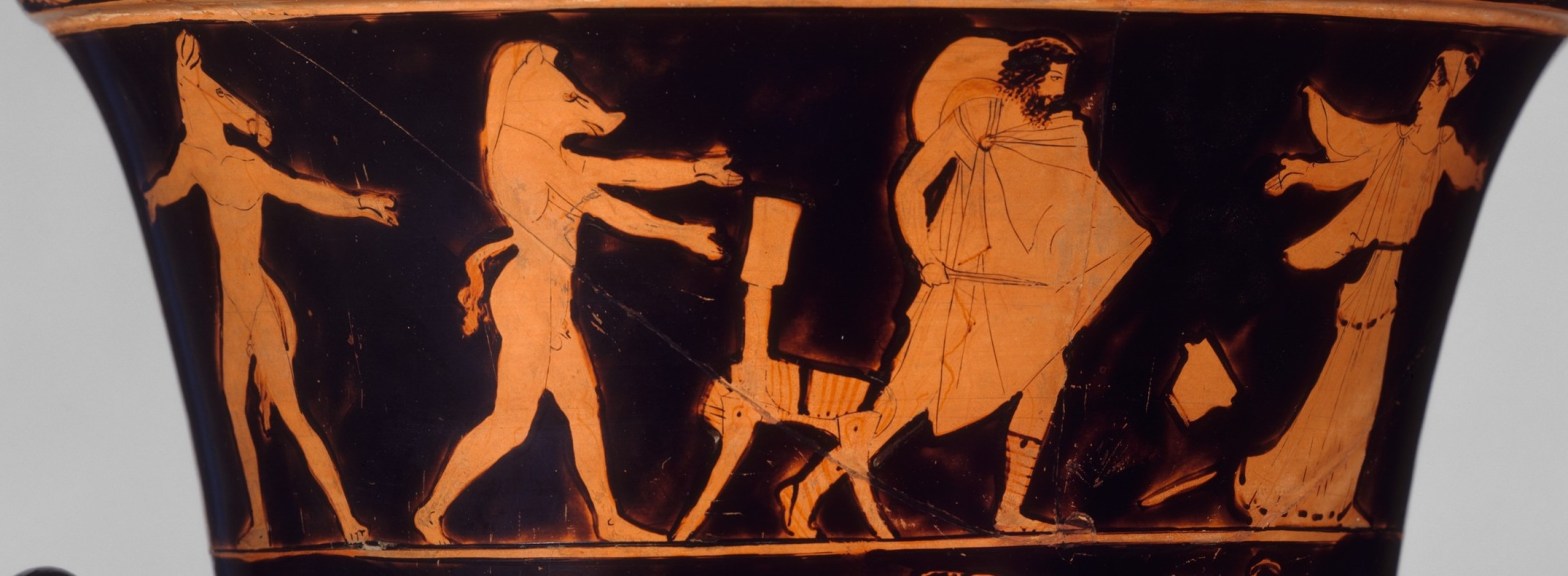
In the upper register of the krater, we see the moment that Odysseus comes to his men’s rescue. Circe appears at far right and behind her, clattering the ground, are her magic wand and the vessel with which she served the men her drugged concoction. Odysseus draws his sword, threatening her. Behind him, two partially transformed men appear to be scrambling in terrified confusion. One has the head and tail of a wild pig and the other seems to be transforming into a horse or mule. By following Hermes’ instructions, Odysseus is able to pacify Circe and convince her to turn his soldiers back into men.
Throughout this episode, Circe behaves outside the confines of Greek convention. She lives alone surrounded by wild animals; she tricks her guests; she has mysterious knowledge that can overcome men; she is free to engage in a relationship with Odysseus; and her magical acuity makes her potentially dangerous. Odysseus’ yearlong stay on Circe’s island provides a narrative obstacle to his ultimate goal of returning home, presenting the sorceress as someone who keeps a man away from his devoted wife. But Circe is also instrumental in helping Odysseus achieve his ends – it is she who instructs him that he must journey to the realm of the dead and aids him in doing so. Daniel Ogden analyzes Odysseus’ visit to the Underworld in another post in this series, while Brett Rogers explores the Odysseus’ interactions with the dead in the same chapter.
How does Circe’s character reveal Greek attitudes about magic? Circe is a volatile figure whose powers can lead to hindrance or assistance. In Greece, magic was often regarded with suspicion and associated with foreign witches, the Underworld, and spirits of the dead. Although those who practiced witchcraft offered the power to heal, they could also intend harm or coercion. While magic was rarely incorporated into civic religion, traditional folk remedies for healing that employed magical charms were common. Itinerant magicians, consulting their magic books, offered their services to wealthy clients. Others provided spells written on metal tablets – two common genres of which are known as ‘curse tablets’ and ‘love spells’ – which were deposited in graves or wells to contact Underworld gods.
We can also consider the significance of this particular scene on this kind of vessel, which held a mixture of water and wine and may have been used by male drinkers at a symposium. Over the course of an evening, as the participants imbibed and became increasingly inebriated, their perspectives on this composition might change. It embodies Greek anxieties about tricky witches, but it’s also humorous. By focusing on the moment when Circe is disarmed, any real sense of the threat she poses is removed, and Odysseus’ outwitting of Circe represents a return to the expected social order. But looking at the half-man, half-beast figures, the symposiasts might be prompted to consider that their drunken state brought them closer to being like animals, blurring the boundaries between civilized men and wild beasts. They might also ponder the transformative possibilities of the substances we ingest, whether they be wine or Circe’s magic potions. The scene thus maintains a sense of tension that invites the viewer to question whether they should feel at ease or on edge.
Additional Resources
Cursed! The Power of Magic in the Ancient World is on view at ISAW through December 13, 2026. The exhibition examines the visualizations and manifestations of magic in ancient Mesopotamia, Egypt, Greece, and Rome from approximately 2000 BCE to 300 CE.
The accompanying exhibition catalogue is available for purchase through ISAW’s website.
Follow the Galleries at ISAW on Instagram @galleriesatisaw
Dr. Sara E. Cole is the Bernard and Lisa Selz Director of Exhibitions and Gallery Curator at the Institute for the Study of the Ancient World at NYU. She holds a PhD in Ancient History from Yale University. Prior to joining ISAW, Sara spent ten years as an antiquities curator at the J. Paul Getty Museum (Villa) in Los Angeles.
Like our content? Consider donating to Peopling the Past. 100% of all proceeds support honoraria to pay the graduate students and contingent scholars who contribute to the project.
Make a monthly donation
Make a yearly donation
Choose an amount
Or enter a custom amount
Your contribution is appreciated. Please note that we cannot provide tax receipts, as we are not a registered charity.
Your contribution is appreciated. Please note that we cannot provide tax receipts, as we are not a registered charity.
Your contribution is appreciated. Please note that we cannot provide tax receipts, as we are not a registered charity.

